
The Australian prime minister also said that he briefed Prime Minister Modi on AUKUS - a trilateral security arrangement between Australia, the UK and the United States that was unveiled in September 2021.

America had postponed the much-awaited dialogue due to "unavoidable reasons" last month.

The Modi government finds itself in a contradiction of its own making. It has encouraged pro-Russian, Westophobic public sentiment while setting strategic policy that's exactly the opposite, points out Shekhar Gupta.

Pak's role in Kabul is not sending a good message to India, a top American lawmaker has said

'India has a strong and proud tradition of strategic autonomy, and we respect that'

The trust some people in India had that the Biden-Harris administration would be friendly to India has been eroded already, observes Ambassador T P Sreenivasan.

The Indian position on the Russia-Ukraine war and the unconditional treaty between China and Russia appear to have caused some ripples in India-US relations and led to a reappraisal of India's usefulness to the US in the eventuality of a conflict with China, notes Ambassador T P Sreenivasan.
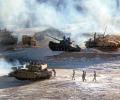
'The Chinese are only about 160-170 km behind.' 'It will not take much time for them to bring their troops back, considering that they have better infrastructure -- and the weather is now favourable.' 'They can move in much faster as the terrain favours them.'

A weaker Russia, a sobered China at a time when Xi Jinping is manoeuvring to protect his third term prospects, a reunited West, a chaotic Pakistan. This is a perfect set of strategic circumstances. It is for India now to consummate this historic opportunity, argues Shekhar Gupta.

US Deputy National Security Adviser Daleep Singh also referred to the 'no limits' partnership between Moscow and Beijing and said no one believes that Russia would come running to India's defence if China breaches the Line of Actual Control.
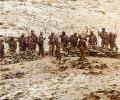
'They talk about their 2021 centenary goal, their 2035 goal, and their 2049 goal. They're accelerating. There's also been this unfortunately bashing of nationalism inside the People's Republic of China by the government'

Prime Minister Narendra Modi on Thursday described India and America as "natural partners" as he held the first in-person meeting with Vice President Kamala Harris at the White House during which they decided to further cement the Indo-US strategic partnership and discussed global issues of common interest, including threats to democracy and the Indo-Pacific.

India has so many relationships, such an ability to communicate and find touch points with different countries and regions.
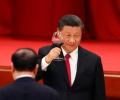
'Having tied himself in knots, he just might take a decision which is dangerous, one that could take his nation to war.'
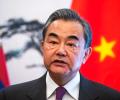
Addressing a symposium on the international situation and China's foreign relations in 2022, Wang said both countries have maintained communication through diplomatic and military-to-military channels.
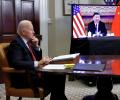
Washington is signalling to Delhi that it can rely on American support in any great game vis-a-vis China. Delhi shouldn't fall into the trap, argues Ambassador M K Bhadrakumar.

'At the heart of the strategic relationship between our countries are economic ties.'

'The MEA, hopefully, made it clear that the Indian PM can't be seen in Xi Jinping's company when China has, for all intents and purposes, annexed over 1,000 sq kms of Indian territory in eastern Ladakh, and essentially that the Wuhan spirit and the Mamallapuram spirit have turned into vinegar.'

'India in 2020 is a lot better prepared than in 1962.' 'It is no longer a pushover; and anything other than a crushing Chinese military victory will be a major loss of face for China,' observes Rajeev Srinivasan in the first of a three part column.
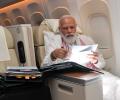
Prime Minister Narendra Modi said on Wednesday that international travel should be made easier through mutual recognition of vaccine certificates, amid several countries adopting different sets of rules to allow foreigners to enter their territory in the wake of the COVID-19 pandemic.
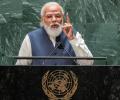
Addressing the 76th UNGA session in New York, Modi called for ensuring that no country 'tries to take advantage of the delicate situation in Afghanistan and use it for its own selfish interests'.
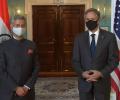
Blinken is scheduled to arrive in New Delhi late on July 27. He is scheduled to attend a full slate of engagements on July 28. During his stay in the country, he will meet Prime Minister Narendra Modi and External Affairs Minister S Jaishankar.

The elephant in the room will permeate the conversations, predicts Rup Narayan Das.

What is being exposed is we have no real doctrine and no idea how to deal with the world, asserts Aakar Patel.
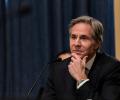
The two sides are also expected to explore ways to deepen defence collaboration, including exercises, defence transfers and technologies ahead of the next edition of the 2+2 defence and foreign ministerial dialogue to be held in the US later this year, they said.

'Good to meet US Secretary of State @SecBlinken today. I welcome President Biden's strong commitment to strengthen the India-US Strategic Partnership, which is anchored in our shared democratic values and is a force for global good,' Modi tweeted.
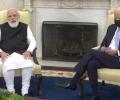
Prime Minister Narendra Modi and US President Joe Biden on Friday remembered Mahatma Gandhi, a week ahead of his birth anniversary on October 2, recalling the values advocated by the apostle of peace of non-violence, tolerance, respect and human trusteeship.

The Congressman said the Chinese Communist Party has, unfortunately, botched its response to COVID-19, causing tremendous economic uncertainty and a slowdown in China's economy.

'Washington appears to be playing the long game, and making the argument to India that over the longer term, Russia -- sanctioned, cash-strapped, isolated by the West -- will no longer be a viable defence partner for India'

Blinken and Indian leaders on Wednesday will discuss a plethora of pressing issues such as the fluid situation in Afghanistan, regional security concerns, COVID-19 response and ways to boost Indo-Pacific engagement, people familiar with the agenda of talks said.
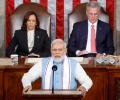
Here's the full text of Prime Minister Narendra Modi's address to a joint session of the United States Congress, delivered on Thursday.

Prime Minister Narendra Modi in his first-ever in-person meeting with President Joe Biden raised a number of issues involving the Indian community in America, including access for Indian professionals in the US and speaking about the H-1B visas, Foreign Secretary Harsh Vardhan Shringla has said.

External Affairs Minister S Jaishankar said on Friday that India and China are going through a 'particularly bad patch' in their ties because Beijing has taken a set of actions in violation of agreements for which it still doesn't have a 'credible explanation' and it is for the Chinese leadership to answer where they want to take the bilateral relationship.

The people will view it from their viewpoint, their immediate interest, historical experiences, their insecurities, he said.

The 2+2 was attended by Secretary of State Antony Blinken and Secretary of Defence Lloyd Austin and their Indian counterparts S Jaishankar and Rajnath Singh respectively.

"We share important interests with India. We share important values with India. And we know India has a relationship with Russia that is distinct from the relationship that we have with Russia. Of course, that is okay," Price told reporters at his daily news conference on Friday.

Modi on the global stage always comes across as a statesman, counselling peace and amity to world leaders even as his policies at home hurt certain sections, explains Virendra Kapoor.

At a time when China is trying to make its foray into South Asia, India should use its shared history to strengthen its ties in the region, says Dr Rup Narayan Das.
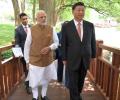
'India's preference today seems to be to exploit the deepening chill in relations with China to breathe new life into its meandering partnership with the US,' argues Ambassador M K Bhadrakumar.
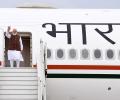
Notably, Pakistan had previously denied the permission of President Ram Nath Kovind and Prime Minister Modi to use Pakistan's airspace thrice to travel to foreign countries in 2019 after India abrogated Article 370 from Jammu and Kashmir.
